


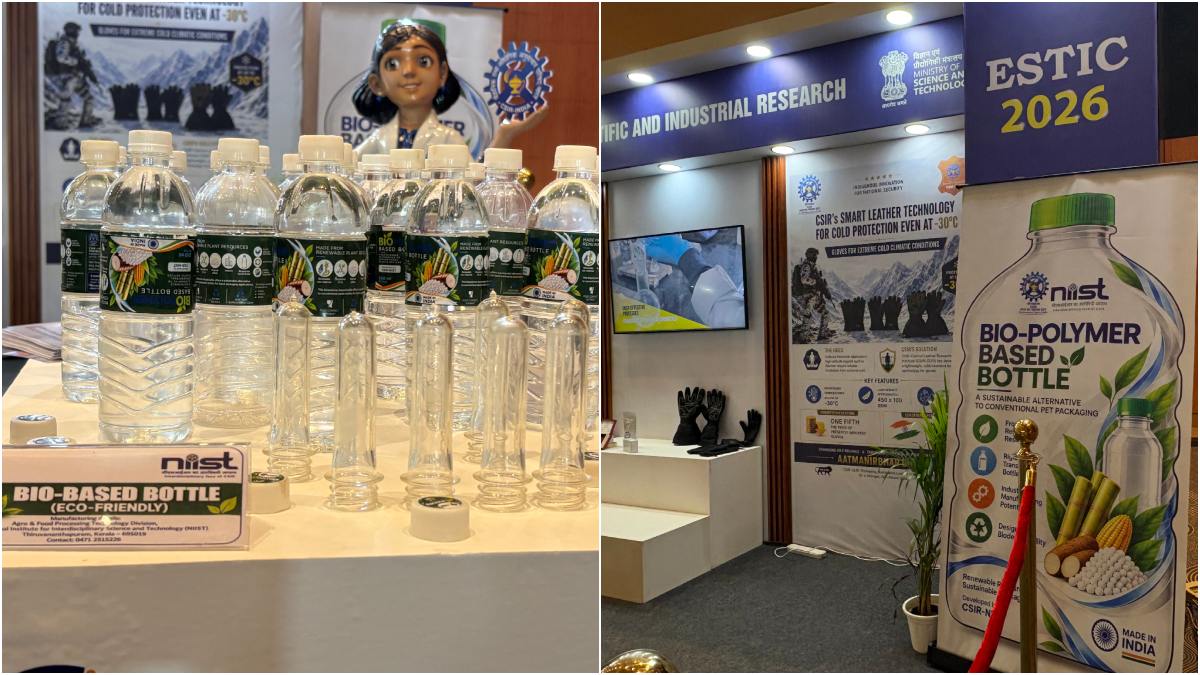
There is an urgent requirement of inventing alternatives to conventional packaging. Scientists at the CSIR-National Institute for Interdisciplinary Science and Technology (NIIST), Thiruvananthapuram, have come out with a bottle that could be an alternative to the ubiquitous plastic bottle. The product is on display at the Council of Scientific and Industrial Research (CSIR) stall in the exhibition being held on the sidelines of the Emerging Science, Technology and Innovation Conclave (ESTIC) 2026. They say that the bottle can break down within months of disposal.
The technology aims to replace conventional polyethylene terephthalate (PET) bottles, widely used for packaged drinking water and beverages.
“We propose to replace the PET bottle, because PET is non-degradable and is causing environmental pollution,” says Dr Anjineyulu Kothakota, the scientist who developed the bio-polymer bottle technology.
Dr. C. Anandharamakrishnan, Director, CSIR-NIIST, said, “The development of sustainable packaging materials is an important step towards addressing the growing challenge of plastic pollution while enabling a transition to a circular bio-economy. Our bio-polymer-based bottle technology demonstrates the potential of materials science to deliver sustainable alternatives to conventional plastic packaging."
According to the developers, the bottle matches conventional PET in clarity and weight and has a shelf life of about a year. Its potential applications include packaging for drinking water, juices, soft drinks and other food products. The scientists have combined biodegradable polymers with agricultural resources in an effort to reduce dependence on conventional petroleum-based plastics. The technology is part of a wider push to develop alternatives to plastic packaging using indigenous materials and research.
How quickly does it break down?
The developers say the bottle degrades in approximately six months under natural conditions. Under composting conditions, where temperatures are higher, the degradation process takes around three months only.
Industry interest builds
The development is part of CSIR’s Sustainable Packaging Mission, which seeks to replace conventional plastic packaging wherever viable alternatives are available. Work on the bottle began about two years ago, according to R.S. Praveen Raj, Scientist responsible for Intellectual Property (IP) Management and Technology Transfer, CSIR-NIIST, Thiruvananthapuram.
"A patent application has already been filed. There are many enquiries for licensing this technology. We prefer to license this know-how on a non-exclusive basis only. Our aim is technology penetration. We want to ensure that the technology benefits reach out to maximum number of people across the country,” says Praveen Raj.
Under a non-exclusive arrangement, multiple companies could obtain licences to use the technology, potentially widening its reach instead of restricting commercial production to a single manufacturer.
Specials
×
Search results for
Bio-polymer alternative to plastic bottles are getting ready for technology transfer
From laboratory research to industry, a plant-based bottle is moving towards commercialisation through a Pune start-up

Disclaimer: Comments posted here are the sole responsibility of the user and do not reflect the views of THE WEEK. Obscene or offensive remarks against any person, religion, community or nation are punishable under IT rules and may invite legal action.
